Showing posts with label Wehrmacht. Show all posts

Sunday, 1 July 2012

Germans on Patrol VIII.

A late war German grenadier platoon under the command of Oberst Henrik Lutz.

Oberst Lutz and command unit.

'Tank Killer' weapons team under Hauptmann Finkel.

First Gruppe, under Leutnant Kuefer.

Second Grupp, under Leutnant Reiniger.

Third Gruppe, under Hauptmann Wechsler.

The whole Platoon.

There is still an MG42 and a mortar team to add to this group.

Figures are from Artizan and Bolt Action.

Sunday, 17 June 2012

Germans on Patrol VII.

A single MG42 team hold a position.

"Schießen!"

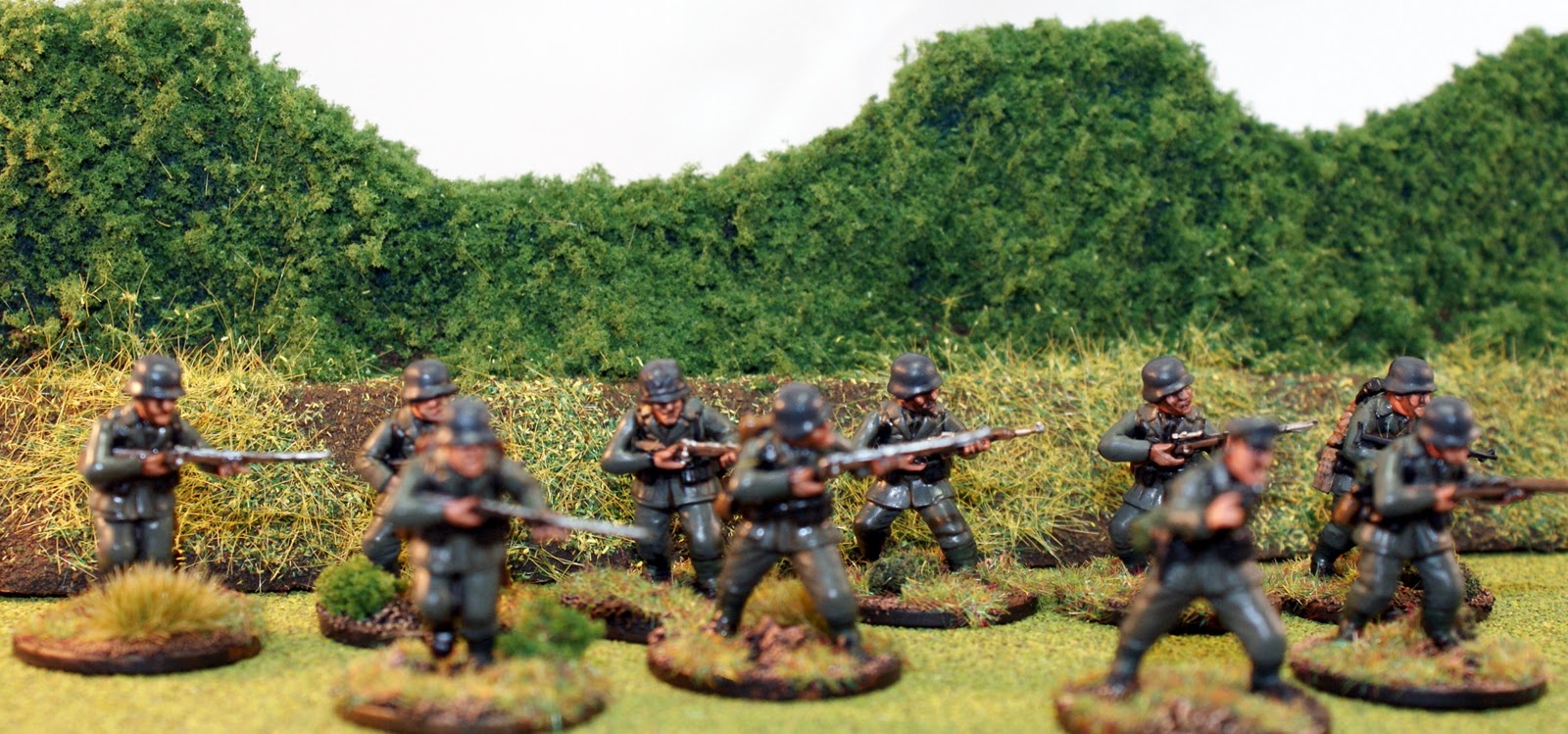
Later war uniforms with 'splinter' camo, of a sort.

Figures are from Bolt Action.

Sunday, 8 April 2012

Germans on Patrol IV.

Oberst Deiter Loewe tries to organise his tired and battle weary men - an understrength platoon of German Heer.

Oberst Loewe and command unit.

First Gruppe, under Leutnant Kortig.

Second Gruppe, under Hauptmann Reinhard.

'Tank Killer' weapons team, under Hauptmann Waechter.

MG42 team.

MG34 team.

The whole Platoon.


Painted using the Army Painter technique.

Figures are mainly Crusader but also Artizan, Black Tree Design and Bolt Action.

Saturday, 5 November 2011

Warlord Games Plastic Germans.

These Germans are from the warlord games/bolt action miniatures plastics set which were £18 for some 25 figures. Thing was I did not enjoy putting them together as they were broken down into lots of fiddly bits (unlike the Perry’s ACW plastics) and were problematic especially when trying to get them to hold the rifle properly. The rifle is cast separate from each of the two arms and the body, requiring some dextrous manipulation to get in the right position before the glue sets. Additionally I have found these to be quite fragile having broken a few weapons while making and painting them. To date I have no idea how well these will stand up to actual use but I suspect a few breakages will be inevitable, hopefully I will find the broken part and be able to stick in back on.


Once complete I do like the look of the figures, I just would have preferred metals rather than put in all this extra work as mostly it’s not the price but the time that is my limiting factor.

When painting them I used army painter for the first time. Painted a base coat, then army painter, then highlight or 1 or two levels depending on how it looked. I am not certain this helped speed things up enough to make it worthwhile doing again but overall I am quite happy with the results. I will probably use army painter again, perhaps on some darkest Africa stuff or when a poorly painted figure needs some rescuing. rather than resorting stripping and repainting. 

When carefully moving the figures to be photgraphed a captains pistol was broken which added to my concerns of robustness during gaming.

Saturday, 10 September 2011

German Squad Structure and Weapons.

Grenadier Squad.

Squad Leader (NCO or junior officer) – Pistol and MP40 SMG
SMG Team (2 men, gunner / loader) – MG34/MG42, Pistol, Kar98k Rifle

2nd in Command (NCO) – Pistol and MP40 SMG/Kar98k Rifle
Rifle Team (6/5 men) – Kar98k Rifles

Panzergrenadier Squad.

Squad Leader (NCO or junior officer) – Pistol and MP40 SMG
SMG Team (2 men, gunner / loader) – MG34/MG42, Pistol, Kar98k Rifle
Rifleman (2) – Kar98k Rifle

2nd in Command (NCO) – Pistol and MP40 SMG/Kar98k Rifle
SMG Team (2 men, gunner / loader) – MG34/MG42, Pistol, Kar98k Rifle
Rifleman (2) – Kar98k Rifle

The first section/team was the ‘fire’ team who would lay down the main suppressing (and killing) fire of the squad. Either the squad leader or the 2nd would lead this. The second section/team was the ‘manoeuvre’ element of the squad. They would close range / flank the enemy using small arms fire and grenades.

The squad may sometimes be supported by and extra anti-tank team of 2 men carrying Panzerfausts or Panzerschrecks and Kar98k rifles.

Of course there are always variations to this, especially as the war progressed. Many units were often undermanned even after re-supply.

These are the most common weapons of the Germans soldier:

Pistols -
http://en.wikipedia.org/wiki/Luger_P08_pistol (early war but most kept hold of them)
http://en.wikipedia.org/wiki/Walther_P38 (newer issue pistols)

Rifle -
http://en.wikipedia.org/wiki/Kar98 (standard issue rifle)

LMG -
http://en.wikipedia.org/wiki/MG_34 (the standard squad LMG)
http://en.wikipedia.org/wiki/MG_42 (a new heavier version of the above with devastating firepower!)

SMG -
http://en.wikipedia.org/wiki/MP_40 (the classic SMG used by Clint in "Where Eagles Dare")

Individual anti-tank -
http://en.wikipedia.org/wiki/Panzerfaust (one shot)
http://en.wikipedia.org/wiki/Panzerschreck (reusable)

For an extensive look at many of the weapons the Germans used http://en.wikipedia.org/wiki/Category:World_War_II_German_infantry_weapons

WWII Squad Structure.

WWII Squads:

US Army Infantry Squad - 12 men: Squad leader (Thompson submachine gun 'SMG', M1 carbine, or M1 Garand rifle), 10 rifleman (M1 Garand rifle), 1 automatic rifleman (BAR). Organized as: Able Team (2 scouts); Baker Team (5 rifleman), Charlie Team (3 rifleman + BAR). One rifleman per platoon would generally carry a bazooka in addition to his personal weapon. There were 3 rifle squads per platoon in a rifle company.

US Airborne Infantry Squad - 12 men: same as infantry squad except that the BAR is replaced by a M1919A1 light machine gun (LMG). Same organization as the regular infantry squad. In practice the organization was flexible to the mission with one or more rifles often replaced by submachine guns and one man in the squad carrying a bazooka (generally one per platoon).

USMC Rifle Squad - 13 men (1944): The marine squad evolved throughout the war, adding additional firepower with each increment until settling on the 13-man configuration in mid 1944. Organized with a squad leader (Thompson SMG), and 3 x 4-man fire teams (3 rifles + 1 BAR each). In addition to the assigned personal weapons, the company commander could allocate 1 demolition pack and 1 flame thrower per squad as well as 1 bazooka per platoon, depending on mission requirements. These weapons would be carried by one of the squad's rifleman in addition to a personal weapon (often an M1 carbine to lighten the load). Since marines were often engaged in close-in fighting, they would frequently scrounge Thompson SMG's to replace rifles when available.

British & Commonwealth Infantry Squad (Section) - 10 men: Section leader (Sten SMG), Assistant Section Leader (rifle), 6 riflemen (rifle), Bren Number 1 (Bren LMG), Bren Number 2 (rifle). British and Commonwealth forces carried the .303 Enfield rifle (bolt action) throughout the war. The basic squad structure remained constant throught different battalion types (e.g., infantry, motorized, parachute), while the Para's were able to add additional Sten guns based on mission requirements. PIAT anti-tank weapons were allocated to squads from the company level as in the US forces.

Germany (Gruppe) – 10/9 men: The basic German squad centered around an MG34 or MG42 general purpose machinegun (GPMG); personal weapons for the gunners were pistols and rifles (generally), squad leader (MP40 SMG), 7 riflemen (Karabiner 98K 'Mauser' bolt action rifle). As the war progressed and manpower losses mounted the Germans were forced to reduce squad size to 9 men (dropping a rifleman). Panzergrenadier squads (halftrack mounted) had 8 dismounts with 2 GPMGs; Fallschirmjager (paratroop) squads were authorized 11 men, also with 2 GPMGs. In 1944 and 1945 many squads were below authorized strength even after replacements.

USSR - 10 men: The basic infantry squad included a squad leader (SMG), assistant leader (rifle), 5 rifleman (rifle), machinegunner (DP light machinegun), assistant gunner (rifle). Like the Germans, the Soviet forces suffered under terrible casualties and were frequently forced to reduce squad size. They also formed SMG squads of 9 or 10 men all armed with the PPsh 41 submachinegun for close-in assault. In some configurations, the SMG squad would be supplemented with an LMG.

Japan - 13 men: The squad consisted of an NCO squad leader, a machinegunner (Type 96 LMG), and 11 riflemen. All carried bolt action rifles (Arisaka) except the machinegunner. The Japanese did not employ submachineguns in any significant numbers.

Sunday, 4 September 2011

Wargames Foundry Kubelwagen.

Got around to putting together my Kubelwagen from the apparently diminishing Wargames Foundry WW2 28mm range. It seems this is no longer available from them. Shame as I have a soft spot for the Foundry range - they tend to come up a bit smaller than some other makes like Crusader Miniatures, Artizan or Black Tree but they have some great sculpts with plenty of character. I am fortunate enough to have nearly 40 each of the German Infantry and British Commandos and my brother in law Jim is kindly painting about 20 more fallschirmjager for me. I may have to treat myself to the 'England Invaded' collection. Who can't love the 'Home Guard Heroes' or 'Downed German Air Crew' sets!


Back to what I do have...I can't currently decide whether to have the kubelwagen with or without its driver and passengers? One of my gaming buddies suggested I should have three - one with, one without and one destroyed/wrecked! Perhaps later Rob...for now I have a fair amount of wehrmacht troops to get sorted first!

A couple of (badly lit) pictures below with some minor progress...

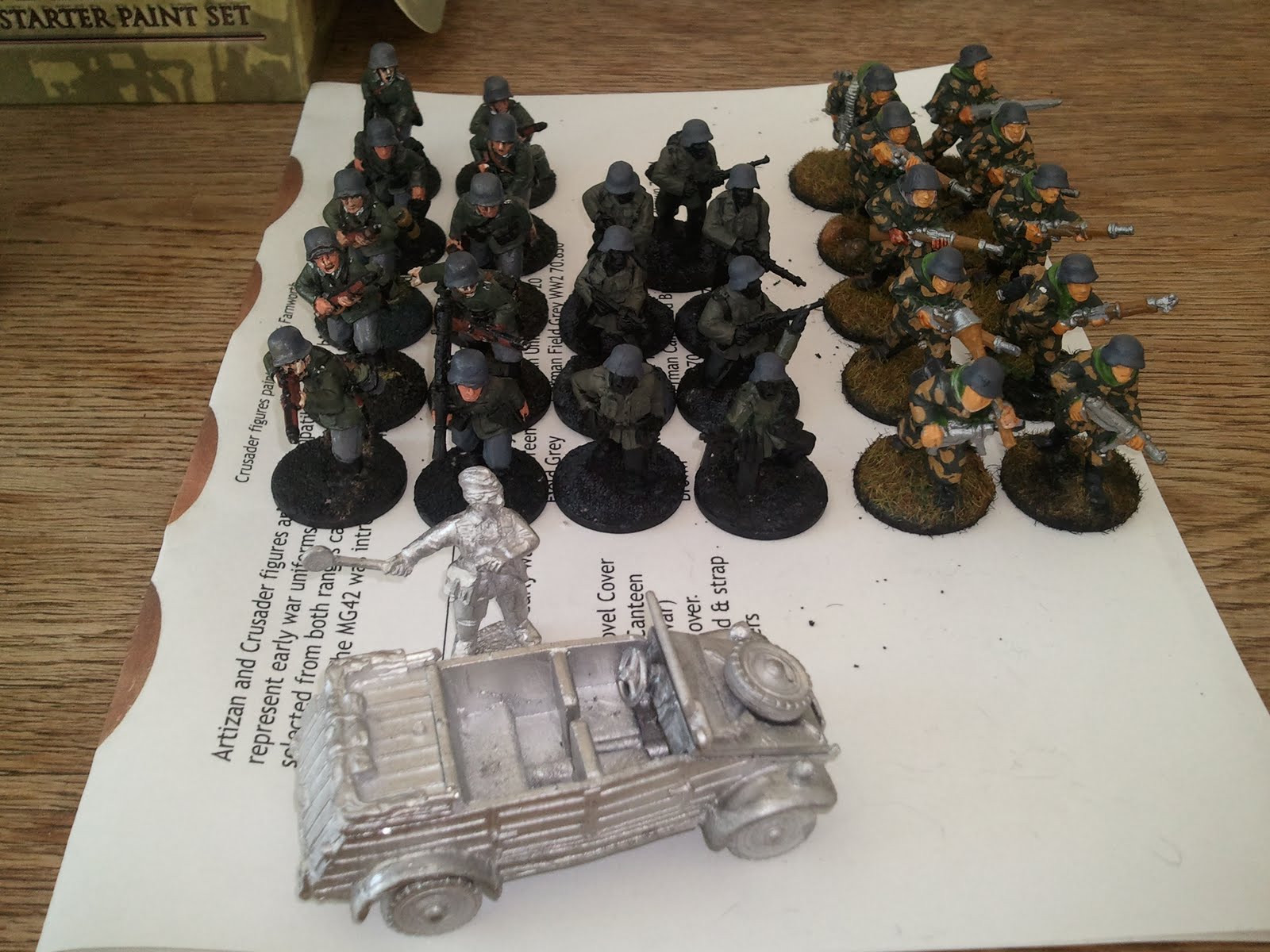
Nearly finished / just started German infantry and kubelwagen without driver etc.

Kubelwagen with driver and passengers.

Figures shown from left to right are Wargames Foundry, Artizan 'Heer' and Artizan 'late war' Germans.

Saturday, 27 August 2011

Germans on Patrol II.

Here is my second batch of painted German Wehrmacht. To be honest they are not all complete (some of them look like they are walking across a sandy beach at the moment) and I need to add a couple more men with an MG34 and ammo to complete a squad but I couldn't resist posting an update!

A squad under the command of Leutnant Adler set up a defensive position in a ruined farmhouse...

Adler postions his MG42 team.

Feldwebel Trommler sets up his mortar team for best effect.

Obergefreiter Mauer leads his rifle section to the perimeter of the farmhouse.

A 'birds eye' view of the defensive position.

Meanwhile, Sturmscharfuhrer Ritter and his spotter Unterscharfuhrer Hahn take up a vantage point in the tree-line.

Finally, satisfied that the objective is secure, Leutnant Adler and Obergefreiter Mauer move the squad to a secondary position...

Figures are a mix from West Wind, Wargames Foundry, Bolt Action and Black Tree Design.

New German Recruits.

Based and undercoated the bulk of my unpainted Germans. Doubt I will try to paint them all in one go (like I did with my Viking horde!) but will select the ones I fancy and try to build them up as squads and add a couple of officers as I go.

The new Wehrmacht recruits.

Generaloberst Florian Hoffmann and his staff.

Figures are from Crusader and Artizan.

Next job is to base and undercoat my 30 or so Fallschirmjager.

Saturday, 16 July 2011

Germans on Patrol.

Been slowly working on one or two German Heer for a while (in between Vikings and WW1 Russians) to add to the small bunch of 'Jerries' for our WW2 project. Here is Hauptmann Klaus Degl leading a group of men on a patrol of a ruined farmhouse...
Hauptmann Degl sends forward Gefreiter Ochs under the cover of Unterfeldwebel Schirlitz.


Degl leads his men to check the other side of the ruined building.

The Hauptmann and his men secure the perimiter. To the right, Oberfähnrich Stahl surveys the area ahead with his sniper, Obergefreiter Dennhardt, in tow...

Figures from Artizan, West Wind, Crusader and Bolt Action.