Wednesday, 11 April 2012

The Russians are Coming II!!

More Russian infantry. Late war Eastern Front.

Russian Squad under Serzhant Pavel Malinovsky.

Russian uniform from the Imperial War Museum.

Still a work in progress - lots more to do!

Figures are all Bolt Action.

Sunday, 8 April 2012

Germans on Patrol IV.

Oberst Deiter Loewe tries to organise his tired and battle weary men - an understrength platoon of German Heer.

Oberst Loewe and command unit.

First Gruppe, under Leutnant Kortig.

Second Gruppe, under Hauptmann Reinhard.

'Tank Killer' weapons team, under Hauptmann Waechter.

MG42 team.

MG34 team.

The whole Platoon.


Painted using the Army Painter technique.

Figures are mainly Crusader but also Artizan, Black Tree Design and Bolt Action.

Saturday, 10 March 2012

Fallschirmjäger II.

9th April, 1940. A small unit of Fallschirmjäger under the command of Leutnant Dreher, soon after landing as part of Operation Weserübung in Denmark.

Leutnant Dreher and his squad just outside Aalborg Air Base.

The squad MG34 sets up.

Dropped far from the others, Jager Schmidt runs to rejoin the squad!


2nd unit, again painted as early war Fallschirmjäger.

Figures are all Wargames Foundry. Sorry the photos are a bit blurred!


Saturday, 25 February 2012

M4 Sherman Tank.

US troops and a Sherman with Culin hedgerow cutter advance on a Belgian town.

The M4 was originally designed to replace the (stopgap) M3 medium tank, as a medium tank armed with a 75mm gun in a turret, and using many of the components of the M3 to speed production. Two versions of the tank went into production at the end of 1941. The M4 was a tank with a welded hull, characterized by the sharp cornered hull shape, while the M4A1 featured a cast hull with a more rounded shape. The reason for the two styles was that, in order to meet production targets, factories without the ability to handle hull castings were used. These firms could not produce the large armor castings needed for the M4A1 hull, but they were able to produce the welded M4 hull. (In the end, the welded hull variants out-numbered the cast hull versions.)

Sgt. Bill Hey and crew take time out of the cramped interior of their tank.

When the tank first entered combat in North Africa in 1942, it was quite successful, but combat experience showed a number of changes were needed. Some of the changes involved improving protection, as the tank’s armor was insufficient to stand up to the larger German guns. Additional armor was added at the depot level, by welding additional armor over vulnerable areas, such as the ammo storage bins. This armor was called “applique armor”. Additional soft armor was added by crews in the field. This took the form of sandbags, logs, tracks, and other similar materials. This type of add-on protection didn’t really help against anti-tank cannon fire, but was effective against Panzerfaust (Germany’s version of the bazooka) rocket propelled HE rounds.

Gunner Corporal 'Chuck' Miller keeps watch with his Thompson SMG.

The Sherman was first equipped with the with the L/40 75mm M3 Gun, which firing the usual M61 round could penetrate 77 mm at 100m and 61 mm at 1000m. Conditions later in the war necessitated the up-gunning to the L/55 76mm M1A2, which could penetrate 124 mm at 100m and 83 mm at 1000m using the usual M79 round. The M1A2 helped to equalize the Sherman and the PzIV in terms of firepower, although the M4 was still under-powered compared to the Panther's much more powerful L/70 75mm gun.

Corporal Miller in action.

The British-developed Sherman Firefly was up-gunned with the 17 pdr. gun. The 17 pdr. also was 76 mm and had a L/55 barrel, but it introduced a much bigger charge which allowed it to penetrate 140 mm at 100m and 120 mm at 1000m using Mk.IV shot. This gun allowed the Firefly a slight firepower advantage over the Panther, although the blinding muzzle flash due to unburnt powder from the increased charge was a handicap.
Sherman at the Imparial War Museum.

The U.S. Army restricted the Sherman's height, width, and weight so that it could be transported via typical bridges, roads, and railroads. This aided strategic, logistical, and tactical flexibility.

Sherman at the Imperial War Museum.

The Sherman had good speed both on- and off-road. Off-road performance varied. In the desert, the Sherman's rubber tracks performed well. In the confined, hilly terrain of Italy, the Sherman could often cross terrain that some German tanks could not.

Tank crew at Fort Knox 1942.

A typical checklist of a tank crews equipment can be found on the Patton's Troubleshooters website.
M4 Sherman on Wikipedia.

Sherman M4 tank from a plastic 1/48 scale Tamiya kit. Crew are by Artizan.

Thursday, 22 December 2011

Operation Biting.

We join a snippet of the action during the Bruneval Raid, otherwise know as 'Operation Biting', the codename given to a British Combined Operations raid on a German radar installation in Bruneval, France that occurred between 27–28 February 1942 during World War II.

Plan of the assault.

A number of these installations had been identified from Royal Air Force aerial reconnaissance during 1941, but their exact purpose and the nature of the equipment that they possessed was not known. However, a number of British scientists believed that these stations had something to do with the heavy losses being experienced by RAF bombers conducting bombing raids against targets in Occupied Europe. A request was therefore made by these scientists that one of these installations be raided and the technology it possessed be studied and, if possible, extracted and taken back to Britain for further study. Due to the extensive coastal defences erected by the Germans to protect the installation from a sea-borne raid, it was believed that a commando raid from the sea would only incur heavy losses on the part of the attackers, and give sufficient time for the garrison at the installation to destroy the Würzburg radar set. It was therefore decided that an airborne assault, followed by sea-borne evacuation would be the ideal way to surprise the garrison of the installation and seize the technology intact, as well as minimize casualties inflicted on the raiding force.

The Villa ('Lone House') and the Wurzburg Radar ('Henry').

Below are Captain John Ross and Sergeant Tasker as they prepare to assault and hold the beachead at Bruneval to secure the escape of Major Frost and his men during the mission. As Captain Ross discusses his next move with his heavy weapons section, he instructs Sergeant Tasker to take his section to assault the German casemates on the cliff between the radar site and the beach.

Missing nearly twenty of the men assigned to him, Captain Ross and some of his heavy weapons team assess the situation.

Meanwhile, Sgt. Robert "Tusk" Tasker prepares his section for the assault on the German defences.

Sgt. Tasker and his men move out.

For more information on the real Raid on Bruneval see my post on Airborne Raids.

Two men were killed in the operation and six were missing, all of whom survived the war. Two German prisoners were brought back, one of them the Wurzburg's operator. The German report on the raid commented: 'The operation of the British Commandos was well planned and executed with great discipline... although attacked by German soldiers they concentrated on their primary task.' The raid had been a great success due in large measure to the element of surprise. Even while reading an account of the action in a newspaper the Supply Officer of the Glider Pilot Regiment, whose training area the paras shared, did not associate them with the raid.
A Wurzburg Radar at the Imperial War Museum.

It is not easy to quantify what was gained from the operation...but it was very significant indeed. One of the many off-shoots was the construction of three radar and communication vessels known as Fighter Direction Tenders (FDT 217, 216 and 13). The FDTs provided vital radar and communications cover off Normandy from D-Day to D+20. Only when land based radar and communications units became operational in France did they move off station. Their design incorporated two types of radar, one using British frequencies and the other using German frequencies.

Figures are from Bolt Action, Artizan and Crusader.

Wednesday, 9 November 2011

Iron Ivan Games - Disposable Heroes: Point Blank Rules.


From the Iron Ivan Games website:
Point Blank is a brand new squad level skirmish system for 1:1 modern tactical firearm combat. Players are in charge of a squad or several fire teams and control the individual actions of their soldiers, weapon teams, vehicles or support weapons. The rules are focused on the tactical concepts of fire and maneuver, command and control, and morale as well as training and experience. Any period of modern firearms combat can be simulated, from The Great War all the way to today and beyond.
The Point Blank book contains everything you need to run games with infantry, artillery, and vehicles as well as rules for spotting and hiding, as well as night, weather, smoke, and fog. There are three major periods represented for the army lists in the book: WWII (which includes Germany, U.S., Soviet, British, French, and Polish. Vietnam (which includes U.S., ARVN, Australian, NVA, and VC. As well as modern forces for the Global War on Terror or any other modern hot spot (which includes U.S., British, Mujahideen, and Insurgent). Rounding out the book are three scenarios, each one concentrating on one of the periods covered in the book and focusing on a tactical concept. The missions include Combat Patrol, Ambush, and a VIP Snatch. There is lots more besides in this 94 page rulebook to keep players busy and gaming.
Players familiar with our other systems will find there is much familiar to allow them to get to grips with the rules quickly, yet there are some major differences that will keep them on their toes. New players will find the rules play very quickly, with a streamlined and heavily playtested engine built on 10 years of game design experience. The rules are focused on players making tactical decisions over game mechanic decisions. Machine guns can set up crossfires, vehicles have to decide when to load and fire...and each decision can mean the difference between victory or defeat. With the Command and Control, Activation and Action Point, and Training & Experience system, players will find it easy to master the mechanics of the game but will find that the rules allow for challenging tactical simulations. With the Morale and Training & Experience system players can simulate modern asymmetrical warfare, even when there are major disparities in two opposing forces.

Saturday, 5 November 2011

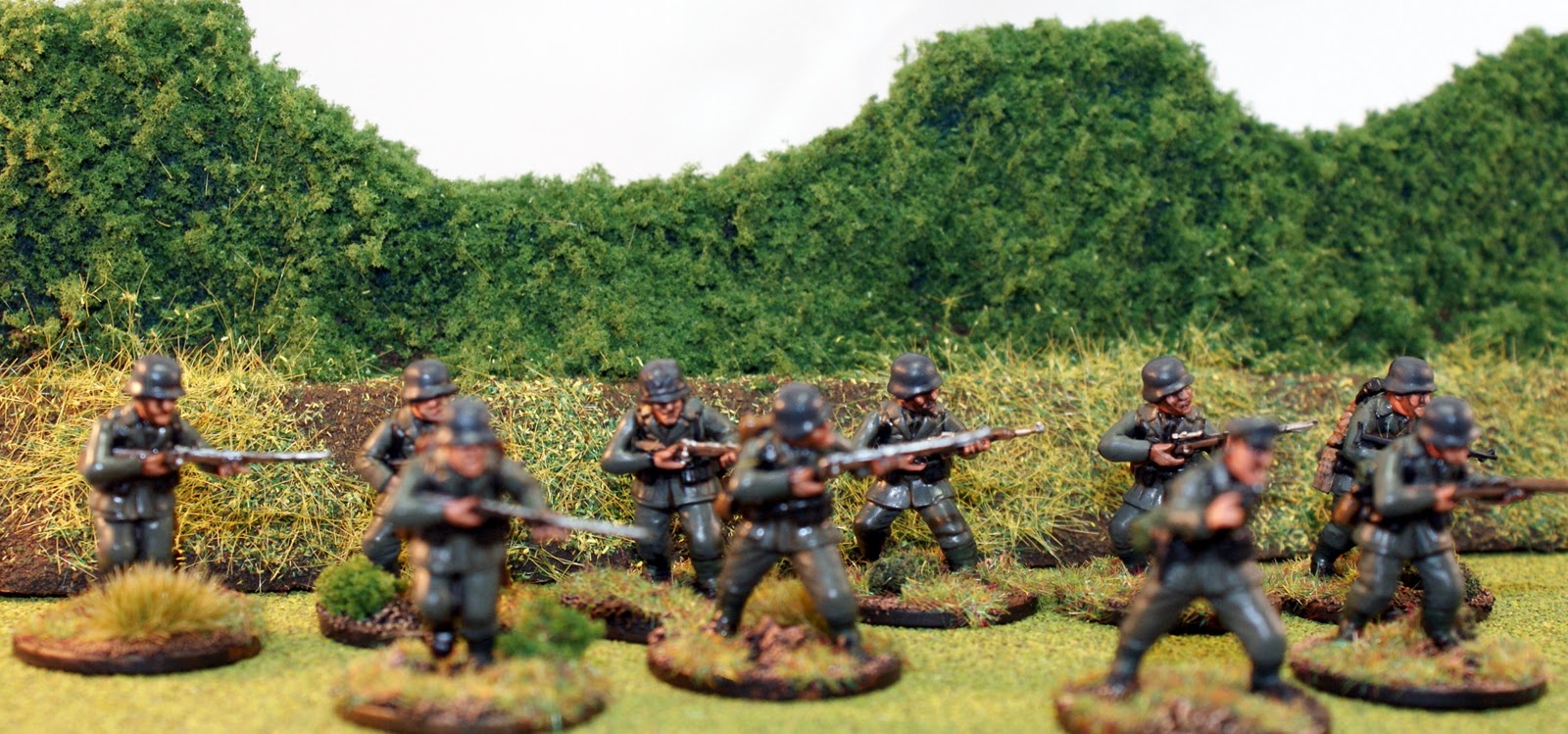
Warlord Games Plastic Germans.

These Germans are from the warlord games/bolt action miniatures plastics set which were £18 for some 25 figures. Thing was I did not enjoy putting them together as they were broken down into lots of fiddly bits (unlike the Perry’s ACW plastics) and were problematic especially when trying to get them to hold the rifle properly. The rifle is cast separate from each of the two arms and the body, requiring some dextrous manipulation to get in the right position before the glue sets. Additionally I have found these to be quite fragile having broken a few weapons while making and painting them. To date I have no idea how well these will stand up to actual use but I suspect a few breakages will be inevitable, hopefully I will find the broken part and be able to stick in back on.


Once complete I do like the look of the figures, I just would have preferred metals rather than put in all this extra work as mostly it’s not the price but the time that is my limiting factor.

When painting them I used army painter for the first time. Painted a base coat, then army painter, then highlight or 1 or two levels depending on how it looked. I am not certain this helped speed things up enough to make it worthwhile doing again but overall I am quite happy with the results. I will probably use army painter again, perhaps on some darkest Africa stuff or when a poorly painted figure needs some rescuing. rather than resorting stripping and repainting. 

When carefully moving the figures to be photgraphed a captains pistol was broken which added to my concerns of robustness during gaming.